Polygons
A polygon is a closed figure where the sides are all line segments. Each side must intersect exactly two others sides but only at their endpoints. The sides must be noncollinear and have a common endpoint.
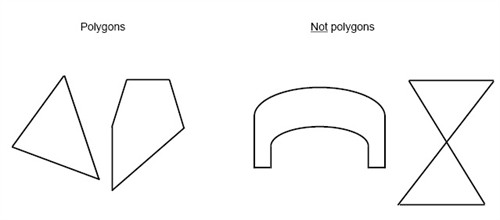
A polygon is usually named after how many sides it has, a polygon with n-sides is called a n-gon. E.g. the building which houses United States Department of Defense is called pentagon since it has 5 sides.
Kindle Unlimited Membership Plans

Kindle Unlimited Membership Plans

Types of Polygons
Regular or Irregular
A regular polygon has all angles equal and all sides equal, otherwise it is irregular
 |  | |
| Regular | Irregular |
Concave or Convex
A convex polygon has no angles pointing inwards. More precisely, no internal angle can be more than 180°.
If any internal angle is greater than 180° then the polygon is concave. (Think: concave has a "cave" in it)
|  | |
| Convex | Concave |
Simple or Complex
A simple polygon has only one boundary, and it doesn't cross over itself. A complex polygon intersects itself! Many rules about polygons don't work when it is complex.
|  | |
| Simple Polygon (this one's a Pentagon) | Complex Polygon (also a Pentagon) |
Interior angles of polygon
An Interior Angle is an angle inside a shape
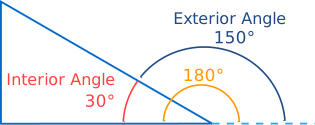
Sum of Interior Angles = (n-2) × 180°
If a polygon is regular (i.e. all of its sides are of equal length and all of its angles are of equal size), then the following rule is true:
Each Interior Angle of a Regular Polygon = (n-2) × 180° / n
Where 'n' refers to the number of sides.

Exterior angles of polygons
The exterior angle of a polygon is an angle between any side of a shape and a line extended from the next side.
When you add the exterior angle of a polygon and its corresponding and exterior angle on a straight line, it amounts to 180°.
As a rule;
The sum of the exterior angles of a simple polygon add up to 360°
This is referred to as a 'full revolution'.
The exterior angle of a polygon and its corresponding interior angle always add up to 180°. This is due to the fact that the two corresponding angles create a straight line:
Exterior angle of a regular polygon = 360° ÷ (number of sides)
This is due to the fact that the exterior angles of a regular polygon always add up to 360°.
 |
| Tables of polygon and their angles |




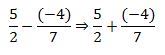

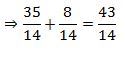

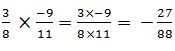
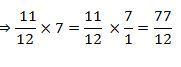


Algebra in daily life
Have you ever taken out a loan? If so, you had to pay interest on the loan. The formulas used to calculate that interest are built using the language of algebra. Businesses have to finance day-to-day operations as well as long term investments, like building a new factory or plant, and they do complex algebraic calculations to decide the lowest cost method of financing.
Are you saving money? If so, you are expecting a return on your money, and it will no doubt be compounded. This is calculated using the rules of algebra. Businesses do the same thing when they manage their investment portfolios.
Have you ever landscaped your backyard or done home improvements? If so, you had to figure out how much area to cover (with paint, with grass, or with weed inhibitor, for example) and how much it would cost for different alternatives. The calculations to cost out the alternatives and figure out how much you need to purchase are done using algebraic rules.
Do you need to make sales projections for next year and the year after? Almost certainly you’ll start out by drawing a line through your sales levels for the past few years and project that into the future. Once again, algebraic rules (in this case, for developing linear equations) will be the ticket.
Have you ever had to adjust a cooking recipe for a different number of people than the recipe was written for? You need to proportionally change the ingredients to match the needed servings. Restaurants have the same challenge. In both cases, algebra is used do the conversions.
Have you ever traveled abroad? If so, you probably had to convert some of your US dollars to the local currency of the country you were traveling in. Companies have to do something very similar if they have any foreign locations for sales or manufacturing or if they purchase any supplies from abroad or sell to any customers in other countries.